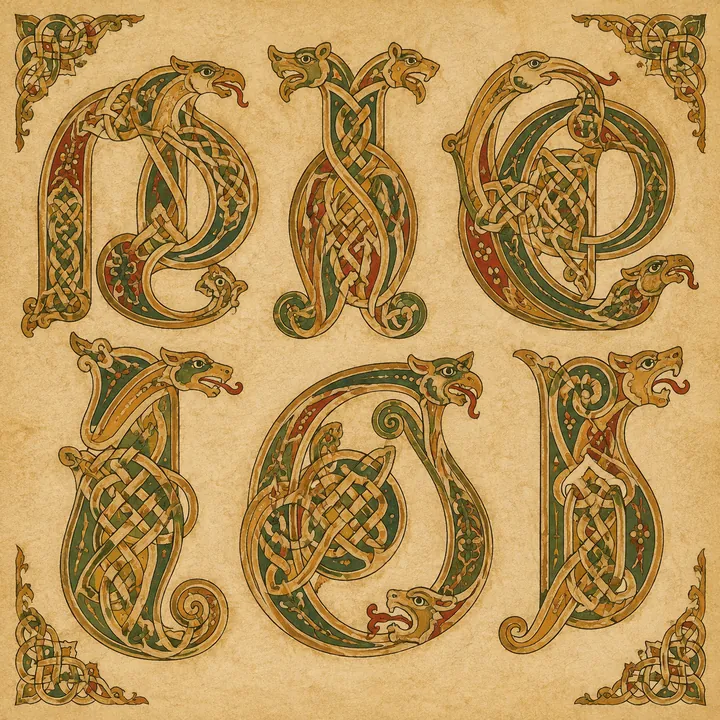
æ
ash (æsc)
Sound: A vowel like the a in modern “cat”. It is one letter, not an a and e stuck together.
Very common: þæt (“that”), æt (“at”), æþeling (“prince”). The letter’s name, æsc “ash tree”, came from the rune it replaced.
Find the character you need, learn its name and what it stood for, then type or copy it straight away.
Inserts at the cursor. þ = thorn (th), ð = eth (th), æ = ash, ƿ = wynn (w), ȝ = insular g; macrons mark long vowels (ā ē ī ō ū ǣ ȳ); ċ ġ are modern editors' dots for palatal sounds.
This pad never sends your text anywhere — it stays in this page.
Old English used the Latin alphabet of its time, plus these letters that modern English has lost. The glyphs below are real text — select them, or use the copy button.
æ
Sound: A vowel like the a in modern “cat”. It is one letter, not an a and e stuck together.
Very common: þæt (“that”), æt (“at”), æþeling (“prince”). The letter’s name, æsc “ash tree”, came from the rune it replaced.
þ
Sound: “th” — both the soft th of “thing” and the voiced th of “this”.
Borrowed from the runic alphabet. Scribes swapped þ and ð freely, so the same word may appear with either letter in different manuscripts.
ð
Sound: Also “th”. In Old English it did not mark a different sound from þ.
Some scribes preferred ð inside a word and þ at the start, but habits varied by writer and period. The capital is Ð.
ƿ
Sound: The “w” sound.
Another runic borrowing. Modern editions usually print w instead, so you will meet the same word both ways: ƿē in a manuscript, wē (“we”) in a textbook.
ȝ
Sound: Several g-like sounds: the g of “god”, the y of “year”, or a soft guttural like the ch of German “ach”.
The handwritten shape of g in Old English manuscripts. Printed editions use plain g; the similar letter in Middle English texts is the one properly called yogh.
These are not medieval spelling. Anglo-Saxon scribes never wrote macrons or dots — dictionaries, grammars and textbooks add them today to show things the manuscripts leave you to know.
ā ē ī ō ū ǣ
Sound: Long vowels — held a beat longer, and length can change the word entirely.
A modern editorial mark, never used by Anglo-Saxon scribes. Dictionaries and textbooks add macrons so learners can see that god (“god”) and gōd (“good”) are different words.
Type these with the pad above — the keyboard includes them.
ċ ġ
Sound: ċ like the ch of “church”; ġ usually like the y of “yes”, sometimes like the j of “bridge” (brycġ).
Another modern editorial convention: the dots warn you that these are the palatal sounds, so ċiriċe (“church”) is not read with a hard k. Manuscripts wrote plain c and g for both.
Type these with the pad above — the keyboard includes them.
Spelling varied by period, by region and from scribe to scribe. Most surviving texts are in the West Saxon dialect, but even two copies of the same work can spell the same word differently. The letters above are simply the ones that look unfamiliar today — the rest was the everyday Latin alphabet, written in the handwriting styles of the time.
Modern editions also normalize spellings and add the macrons and dots shown above, so the same word can look different in a manuscript, a dictionary and a textbook. None of these is “the” eternal alphabet table. For a careful university introduction to Old English spelling and sounds, see Old English Online at the University of Texas at Austin.
You will not find audio on this page yet: we add pronunciation material only when we have recordings we can verify.
þ, ð, æ, ƿ and ȝ are ordinary Unicode characters: they copy and paste into documents, email and messages like any other text, in any modern font. The “Old English fonts” that turn your typing into blackletter shapes only restyle modern letters — a design effect, not the language. If that is what you came for, our comparison guide explains the difference and which tool fits which task.